

Josiah Warren
Josiah Warren (1798-1874) was an American inventor, musician, and social reformer who participated in the New Harmony experiment but became disillusioned with its communal approach, leading him to develop his own philosophy of individualist anarchism based on "individual sovereignty" and "cost the limit of price." After leaving New Harmony, he founded experimental communities and the innovative "time store," where goods were exchanged based on the labor time required to produce them, pioneering equitable commerce principles that valued all labor equally. His radical ideas about voluntary cooperation, individual liberty, and economic justice made him one of America's first anarchist philosophers and influenced later libertarian and mutualist movements, establishing him as a foundational figure in individualist political thought. Learn about his life and legacy here.
Get Started


Who was Josiah Warren?
Josiah Warren, born in Boston in 1798 of famous Puritan lineage, was, to quote an earlier writer, "a man who seeks freedom as water seeks its level." He was known as America's first anarchist, but actually, being modest and unobtrusive, he was more a social philosopher and, if a revolutionary, certainly a very peaceable one.
Warren had a love of music and owned a lamp factory in Cincinnati, where he was attracted by Robert Owen's ideas when Owen lectured there promoting his New Society in 1825. Warren had been associated with Joseph Neef's Pestalozzian School in Kentucky and may have come to New Harmony with Neef. In New Harmony, Warren became the leader of the orchestra/band. Although he rarely spoke in public, wrote little, and published less, he had the same enthusiasm for righteousness as Owen's son, Robert Dale, and served as a social philosophy inspiration to early feminist and abolitionist Frances Wright. John Stuart Mill speaks of Warren as a "remarkable American." Although he remained obscure, he successfully carried out Owen's idea of labor notes and later worked with a group conducting labor schools for boys. He participated in the Owen experiment and later sponsored more than one utopian community, called equity villages, in Ohio and New York.
Warren's greatest work was as an inventor, often in the field of typography. He invented a stereotyping process which brought him financial stability. His other inventions included a cheaper lamp, patented in 1823, which substituted lard for tallow as fuel and gave a better light, and a unique system of music. This system was based on mathematical notation to accomplish, in harmonic sounds, a similar service to that provided by phonography in speech. His most lasting invention, however, was the first printing press that could print on a continuous roll of paper - a boon to newspapers even to this day. This new system was first used by the Southwestern Sentinel in Evansville, Indiana, running sixty copies per minute.
Josiah Warren's interests often took him to other parts of the country, but his family remained in New Harmony. As late as 1856, his son, George, was helping Peter Duclos paint scenery for the theatre.
The unusual ideas, both social and mechanical, generated by Josiah Warren's excellent mind made him the kind of citizen who left his imprint on the future. Warren himself stated, "Freedom to differ is the keynote to social harmony."
Discover More
SEE THIS
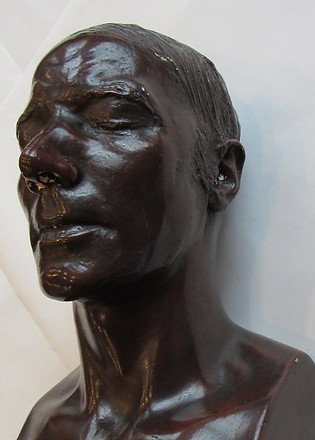
Life Mask of Robert Owen
The Working Men's Institute in New Harmony, Indiana, holds a plaster life mask of Robert Owen in its museum collection. Phrenological caster James DeVille made the cast in London in 1828, a year after Owen departed New Harmony, Indiana, for the last time.

VISIT THIS
Working Men's Institute in New Harmony, Indiana
William Maclure established the New Harmony Working Men's Institute (WMI) in 1838. Today, it is Indiana's oldest continuously operating library. The WMI's special collections and museum house treasures from New Harmony's history, including the Owen-Maclure period.

READ THIS
Education and Reform at New Harmony: Correspondence of William Maclure and Marie Duclos Fretageot, 1820-1833 edited by Arthur E. Bestor, Jr.
This is a compilation of transcriptions of correspondence between William Maclure and Marie Duclos Fretageot held in the archives of the Working Men's Institute in New Harmony, Indiana.


LISTEN TO THIS
William Maclure and New Harmony's Boatload of Knowledge
Check out the August 5, 2019, episode of the Stuff You Missed in History Class podcast:
"When Robert Owen founded his utopian community, he wanted to have the best minds he could find running the educational system. He recruited William Maclure, who in turn brought many great minds with him. Their boat was nicknamed the Boatload of Knowledge."

MEET THIS PERSON
Lucy Sistare Say
Marie Duclos Fretageot was a French educator who played a crucial role in implementing Pestalozzian educational methods at New Harmony, directing schools and teaching programs that emphasized hands-on learning and child-centered instruction. She was one of William Maclure's most trusted collaborators and remained loyal to him throughout the community's struggles, continuing their educational work together even after the utopian experiment dissolved.
Dive Deeper
We've curated a collection of research and resources on Josiah Warren to help you learn more about his life and work. If you can't find what you're looking for here, we may be able to send you in the right direction.

Published Works
A list of Josiah Warren's published writings.

Sites
Places with a connection to Josiah Warren's life and work.

Quotes
Popular quotes by and about Josiah Warren.

Books, Articles, and Websites
A selection of publications about Josiah Warren and his legacy.

Images
Digitized items related to Josiah Warren from libraries, archives, and museums.

Collections
Museums, libraries, and archives with collections related to Josiah Warren.
