


Explore the Story

From 1825 to 1827, New Harmony, Indiana, was home to one of America's boldest social experiments. Robert Owen and William Maclure brought together educators, scientists, artists, and reformers to build a community based on cooperation and reason. Within two years, their partnership collapsed and their community dissolved, but the questions they raised about how we live together have never gone away.
The Owen-Maclure Community
In January 1825, Welsh industrialist Robert Owen purchased the town of Harmonie, Indiana, from the Harmony Society and renamed it New Harmony. He envisioned transforming the settlement into a model community where cooperation would replace competition, where education would be universal, and where reason would guide human relations. Owen believed that if you changed people's environment and education, you could perfect human nature itself.
Within months, hundreds of people arrived in New Harmony. Some were drawn by Owen's ideals, others simply sought land and opportunity. Scientists, artists, and educators came too, many brought by William Maclure, a wealthy Scottish geologist who shared Owen's passion for educational reform. Together, Owen and Maclure attempted to create "a new moral world."
By 1827, it was over. The community had fractured into smaller groups and then dissolved entirely. Owen and Maclure's partnership ended in bitter conflict over finances and philosophy. Yet the ideas tested here in New Harmony about education, labor, equality, and community spread across America and continue to shape social movements around the world today.
Robert Owen's Vision
Robert Owen arrived in New Harmony as one of Britain's most successful industrialists and controversial social reformers. At his cotton mills in New Lanark, Scotland, he had proven that treating workers humanely could be profitable. He reduced working hours, improved conditions, and created schools for workers' children. Yet Owen wanted to go further. He believed that competition and private property were the root causes of human misery, and that only a complete reorganization of society could save humanity from itself.
In New Harmony, Owen proposed a community without private property, where all would share equally in labor and resources. He advocated for universal education starting in infancy, believing that children's characters were formed entirely by their environment. His proposals included separating very young children from their parents to raise them communally. This was an idea that disturbed even some of his supporters and perhaps revealed an authoritarian edge beneath his egalitarian rhetoric.
Owen was a visionary who could inspire thousands with his speeches, but he struggled to manage the practical realities of community life. He spent much of 1825-1826 away from New Harmony, lecturing across America while the community foundered without clear leadership. His idealism clashed with other people's pragmatism, particularly William Maclure's. By 1827, Owen had lost both his fortune and his dream, though he never stopped advocating for social reform until his death in 1858.
William Maclure's Contribution
William Maclure came to New Harmony with a different vision than Owen's. Ultimately, that difference destroyed their partnership. As a wealthy and respected Philadelphia geologist who had created the first geological map of the United States, Maclure was less interested in perfecting human nature than in expanding human knowledge. He believed education, especially scientific education, was the key to social progress.
Maclure recruited and funded the "Boatload of Knowledge," a keelboat journey down the Ohio River that brought some of America's best scientists and educators to New Harmony in the winter of 1825-1826. These people included naturalists Thomas Say and Charles-Alexandre Lesueur, educator Marie Duclos Fretageot who ran the school, and Maclure's extensive scientific library and collections. While Owen dreamed of social revolution, Maclure focused on building institutions (schools, libraries, and scientific societies) that could outlast any single community.
The Owen-Maclure partnership fractured over fundamental disagreements about resources, priorities, and control. Owen had promised Maclure certain properties and authority; those promises went unfulfilled. By late 1826, they were locked in conflict. By 1827, they were dividing assets and going their separate ways. Maclure continued his educational work in Mexico, while Owen returned to Britain.
Despite the experiment's collapse, Maclure's educational legacy endured. His support established schools, libraries, and scientific work that influenced American education and natural science for decades.
The "Boatload of Knowledge"
In December 1825, a keelboat left Pittsburgh, Pennsylvania, carrying what would become known as the "Boatload of Knowledge." Funded by William Maclure, it transported scientists, educators, artists, and intellectuals down the Ohio River to New Harmony. The journey took weeks through winter ice, but the passengers spent the time teaching each other, giving lectures, sharing expertise, and turning the boat into a floating university.
Among them were Thomas Say, who would become the father of American entomology; Charles Alexandre Lesueur, a naturalist and artist; educator Marie Duclos Fretageot; and others who came to shape American science and education. They brought with them Maclure's extensive library, scientific collections, and the conviction that knowledge could transform society.
Many of these people stayed in New Harmony long after the Owen-Maclure community ended, continuing their scientific work, teaching, and publishing. Their presence made New Harmony a center of American natural science in the 1820s and 1830s. In many ways, the Boatload of Knowledge represents what actually succeeded about New Harmony: not the perfection of society, but the advancement of knowledge and the connections between people committed to learning and teaching others.
New Harmony Continues
When the communal experiment dissolved in 1827, New Harmony didn't disappear but transformed. Many of the scientists, educators, and reformers who came for Owen's vision chose to stay, building lives and institutions that would shape the region for generations. The Workingmen's Institute, founded in 1838 by William Maclure, became one of the first free public libraries in America and still serves the community today. The schools continued, the scientific work flourished, and families put down roots. New Harmony evolved from a utopian experiment into something perhaps more remarkable: a real town where people lived, worked, raised children, and kept asking the big questions that brought them here in the first place.
Today, New Harmony remains a vibrant small town where history isn't only preserved but lived. Visitors walk the same streets where Thomas Say studied insects, where Frances Wright challenged convention, and where Madame Fretageot taught children to think for themselves. The Owen-Maclure experiment may have lasted two years, but the community it sparked has endured for two centuries.
New Harmony continually reinvents itself while honoring the radical ideas that make this place unique.
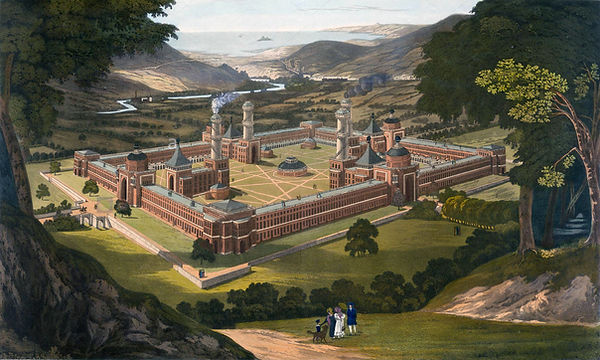
Robert Owen's original vision for his utopian community in New Harmony, Indiana.

Map of New Harmony, Indiana, in 1824.

Portrait of William Maclure and pupils in New Harmony, Indiana.

A replica of the Philantropist, nicknamed the "Boatload of Knowledge," situated on the Wabash River during the filming of the 1980 New Harmony Experience film.
_JPG.jpg)
Natural history specimens, books, and examples of scientific illustration on display at the New Harmony Working Men's Institute during the 2025 Heritage Artisans Days festival.