


Thomas Say
Thomas Say (1787-1834) was an American naturalist known as the "Father of American Entomology" who made groundbreaking contributions to the study of insects and mollusks, describing thousands of new species and establishing systematic approaches to their classification. At New Harmony, he found an intellectual haven where he could pursue his scientific research while teaching and mentoring others, producing major works including American Entomology and American Conchology during his time there. His meticulous descriptions and illustrations of North American fauna laid the foundation for these scientific fields in the United States and remain influential in taxonomy today. Learn about his life and explore his legacy here.
On This Page:
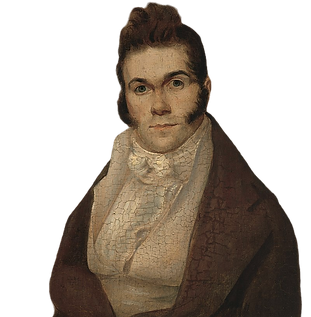

Who was Thomas Say?

Thomas Say, William Maclure's closest friend and one of the most highly respected scientists on the "Boatload of Knowledge," was a tall, soft-spoken, composed Quaker gentleman whose father was a physician in Philadelphia, Pennsylvania. Born in 1787, Say was destined by his father to be a businessman, but he did not do well in business as he had a yearning all his life to pursue natural history. In many ways, Thomas Say was more akin to his financial mentor, William Maclure, than his own father. Maclure entered Say's life shortly after the death of Benjamin Say to fill a role left suddenly vacant. Say served as a volunteer during the War of 1812 and, following the war, resumed his study of natural history. He became a professor of natural history at the University of Pennsylvania.
Say was a charter member of the association that founded the Philadelphia Academy of Natural Sciences. Although he was reticent and modest, he became an internationally known scientist. His name was given to species in every branch of natural science, and he contributed over one hundred articles to the scientific journals of his day. It has been said of him that no department of natural science was left untouched and none he touched unconquered.
Say accompanied William Maclure on an investigation of the Florida peninsula; in 1818, he explored the coast of Georgia. In 1819, he was made chief zoologist of a Rocky Mountain expedition, and in 1823, accompanied Long's expedition to St. Peter's River. Often called the "Father of American Zoology," he went on an expedition to Mexico to collect insects and shells.
Thomas Say gained fame for himself and New Harmony by producing two definitive scientific books. American Conchology, in six parts, was the first of its kind. This work, a study of shells, was illustrated by seventy-seven beautiful plates, which were hand-colored by his wife, Lucy Sistare Say. The second book for which Say is known is American Entomology, in three parts. This work on insects, dedicated to Maclure, made Say the "Father of American Entomology." With these awesome scientific credentials, it perhaps makes him more real to us to know that it was Say who brought the Osage Orange (sometimes called hedge apple) to New Harmony and named it Maclura pomifera after his friend Maclure. Even more real to us is that he named the species Pyractomena angulata, or Say's Firefly, while living in New Harmony.
Although Say was curator of the American Philosophical Society and so well-known internationally that Maximilian, Prince of Wied, came to New Harmony especially to see him, it was not these inheritances that he left for the community. Rather, it was his kindness and gentleness that made him such a remarkable teacher. Victor Duclos, one of his students, says in his diary, "He was beloved by the whole community." Say taught at Community Building No. 5 and his scholars loved him.
Say died prematurely in 1834 and is buried in the garden of the Rapp-Owen-Maclure House.
Adapted from Janet R. Walker, "Thomas Say and Lucy Sistare," in Wonder Workers on the Wabash (New Harmony, IN: Historic New Harmony, 1999), 11-13.
