

Joseph Neef
Francis Joseph Nicholas Neef (1770-1854) was a Swiss American educator who studied directly under Johann Heinrich Pestalozzi in Switzerland and became one of the first teachers to bring Pestalozzian educational methods to the United States, establishing progressive schools in Philadelphia and Kentucky before joining New Harmony. At New Harmony, he served as one of the community's leading educators, implementing hands-on, nature-based learning approaches that emphasized physical education, practical skills, and respect for children's individual development. His pioneering work in progressive education and his influential book, Sketch of a Plan and Method of Education...Suitable for the Offspring of a Free People, and for All Rational Beings, helped introduce European educational reform ideas to America, making him a foundational figure in American progressive pedagogy. Learn about his life and legacy here.
Get Started


Who was Joseph Neef?
Francis Joseph Nicholas Neef was born in 1770 in Alsace, France. He served in the French Army when Napoleon was a rising young artillery officer. In 1796, Neef received a serious head wound and, while recovering, read the works of the great educator Johann Heinrich Pestalozzi. Upon recovery, he applied for a position at Pestalozzi's school in Switzerland, and in 1800, joined the facility to teach foreign language. Pestalozzi headed a greatly admired school where students were responsible for their own discipline, and democracy was the order of the day. William Maclure thought that Pestalozzi's school was the most rational system of education he had ever seen. Robert Owen had followed the system in setting up his school for the New Lanark Mill children.
In 1803, Neef married Luise Buss, by proxy, because Neef was in Paris at the time and Miss Buss, as an unmarried woman, was not allowed to travel alone.
In 1806, Maclure persuaded Neef to open a similar school in Philadelphia, Pennsylvania. When Neef came to America he modified the Pestalozzian method of education. He believed in education for all levels, not just for the poor. Neef questioned the theory of educating according to class; in America, especially on the frontier, class distinctions were negligible. He stated that in his humble opinion, "Education is nothing less than the gradual unfolding of the faculties and powers which Providence chose to bestow on man." After founding several less-than-successful schools in the East, Neef moved to Louisville, Kentucky, in 1815. In Louisville, the last two of the Neef children were born. Neef had brought Josiah Warren with him as an assistant, but their Louisville school was not a success. Neef decided to give up teaching and moved his family to a farm in Shelby County, Kentucky.
Again, at the urging of Maclure, Neef left his farm and came to New Harmony, Indiana, in March of 1826. In New Harmony, Neef was put in charge of the boarding school in Community House No. 2. Mrs. Neef taught in this school as did most of the scientists, including Gerard Troost, Thomas Say, Charles Alexandre Lesueur, and the three oldest Neef children.
Neef was a simple, straightforward, cordial man, who had a roughness about him. He was a good musician with a wonderful bass voice so strong it was said he could give commands to 10,000 troops. It was this voice, his fierce language, and his dreadful military profanity that frightened the children and probably kept them in line. Years later elderly adults well remembered the profound effect the boarding school had had on them. A simple man, Neef usually wore linen shirts with trousers and often went barefooted and bareheaded.
When the Duke of Saxe-Weimer, also a native of Alsace, visited New Harmony, it was specifically to see Neef, of whom he had heard. After meeting Neef he wrote that he appeared aged (actually he was 58) and that he was still "full of the maxims of the French revolution. Neef talked of the emancipation of slaves, was captivated by the system of equality, and openly proclaimed himself an atheist."
Discover More
SEE THIS
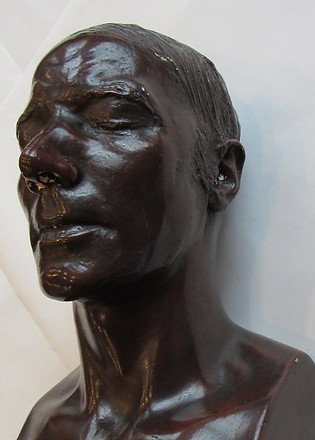
Life Mask of Robert Owen
The Working Men's Institute in New Harmony, Indiana, holds a plaster life mask of Robert Owen in its museum collection. Phrenological caster James DeVille made the cast in London in 1828, a year after Owen departed New Harmony, Indiana, for the last time.

VISIT THIS
Working Men's Institute in New Harmony, Indiana
William Maclure established the New Harmony Working Men's Institute (WMI) in 1838. Today, it is Indiana's oldest continuously operating library. The WMI's special collections and museum house treasures from New Harmony's history, including the Owen-Maclure period.

READ THIS
Education and Reform at New Harmony: Correspondence of William Maclure and Marie Duclos Fretageot, 1820-1833 edited by Arthur E. Bestor, Jr.
This is a compilation of transcriptions of correspondence between William Maclure and Marie Duclos Fretageot held in the archives of the Working Men's Institute in New Harmony, Indiana.


LISTEN TO THIS
William Maclure and New Harmony's Boatload of Knowledge
Check out the August 5, 2019, episode of the Stuff You Missed in History Class podcast:
"When Robert Owen founded his utopian community, he wanted to have the best minds he could find running the educational system. He recruited William Maclure, who in turn brought many great minds with him. Their boat was nicknamed the Boatload of Knowledge."

MEET THIS PERSON
Lucy Sistare Say
Marie Duclos Fretageot was a French educator who played a crucial role in implementing Pestalozzian educational methods at New Harmony, directing schools and teaching programs that emphasized hands-on learning and child-centered instruction. She was one of William Maclure's most trusted collaborators and remained loyal to him throughout the community's struggles, continuing their educational work together even after the utopian experiment dissolved.
Dive Deeper
We've curated a collection of research and resources on Joseph Neef to help you learn more about his life and work. If you can't find what you're looking for here, we may be able to send you in the right direction.

Published Works
A list of Joseph Neef's published writings.

Sites
Places with a connection to Joseph Neef's life and work.

Quotes
Popular quotes by and about Joseph Neef.

Books, Articles, and Websites
A selection of publications about Joseph Neef and his legacy.

Images
Digitized items related to Joseph Neef from libraries, archives, and museums.

Collections
Museums, libraries, and archives with collections related to Joseph Neef.
