


Thomas Say
Father of American Entomology
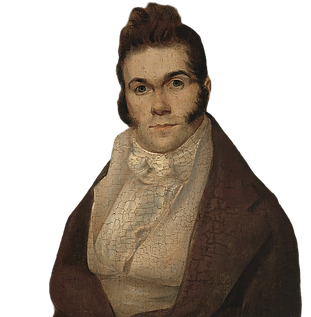
Thomas Say (1787–1834) was an American naturalist who is often called the "Father of American Entomology," the study of insects, along with many shells and other animals. He spent the last years of his life in New Harmony, where he completed his most important books.
Learn about his life and explore his legacy here.

Biography
Thomas Say was one of the first scientists to study and name the insects and shells of North America. Before his work, most American species had been described by scientists in Europe. Say showed that Americans could do this work themselves, and he did much of it in New Harmony.
Early Life
Say was born in Philadelphia in 1787 to a Quaker family. His great-grandfather was the famous botanist John Bartram. As a young man, Say tried to run a pharmacy, but the business failed. He was more interested in collecting insects and shells. In 1812 he helped found the Academy of Natural Sciences of Philadelphia, one of the first scientific societies in the country.
Exploring the West
Say soon became known for his careful work in the field. In 1817–18 he traveled to Florida with William Maclure and other naturalists to collect specimens. In 1819–20 he served as the zoologist on Major Stephen Long's expedition to the Rocky Mountains. On that trip, he wrote the first scientific descriptions of several western animals, including the coyote. In 1823 he joined Long's second expedition to the upper Mississippi River.
Say began publishing American Entomology in 1824. The book described North American insects and included colored illustrations. It was one of the first major scientific works produced entirely in the United States.
Coming to New Harmony
William Maclure invited Say to join him in New Harmony. In the winter of 1825–26, Say traveled there aboard the "Boatload of Knowledge." Also on board was Lucy Way Sistare, a student of Marie Duclos Fretageot. Thomas and Lucy married in 1827. Lucy was a skilled artist, and she drew and hand-colored many of the illustrations for her husband's work.
Science on the Frontier
In New Harmony, Say taught natural history and continued his research. Using Maclure's printing press, he published American Conchology, a book about shells, beginning in 1830. Lucy Say created many of its illustrations. Say also helped manage Maclure's property in New Harmony after Maclure moved to Mexico.
Life in New Harmony was difficult at times. Say worked long hours and had little money. Scientific friends in the East urged him to return to Philadelphia, but he chose to stay. He believed New Harmony was the right place to continue his work and Maclure's.
Final Years and Legacy
Say died of typhoid fever in New Harmony in 1834. He was only forty-seven years old. He is buried in New Harmony, and his tomb can still be visited today. The scientific names he gave to many species are still in use. Lucy Say continued to support his legacy. In 1841 she became the first woman elected as a member of the Academy of Natural Sciences of Philadelphia.
Today, Say is remembered as one of the founders of American natural history. His work showed that important science could be done far from the large cities of the East. In New Harmony, he helped build a scientific community that earned the town international attention.

Works Cited
Stroud, Patricia Tyson. Thomas Say: New World Naturalist. Philadelphia: University of Pennsylvania Press, 1992.
Weiss, Harry B., and Grace M. Ziegler. Thomas Say, Early American Naturalist. Springfield, IL: Charles C. Thomas, 1931.