

Richard Owen
Richard Owen (1810-1890) was another of Robert Owen's sons who became a prominent Indiana educator, scientist, and public servant, serving as a professor of natural sciences and helping to shape the state's educational institutions. At New Harmony, he continued the community's scientific tradition, working in geology and natural history while also engaging in politics and serving in the Indiana legislature. His most significant contribution was serving as the first president of Purdue University and advancing higher education in Indiana while also helping to establish the Indiana Geological Survey and promoting scientific research in the state. Learn about his life here.
Get Started
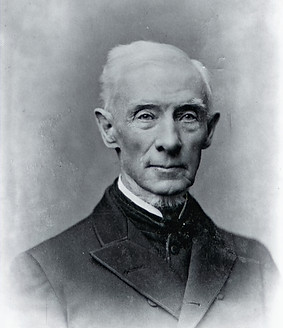

Who was Richard Owen?
Born in 1810, Richard was but 14 years old when his father Robert Owen bought Harmonie, Indiana, so he did not come to America until three years later. Soon after his arrival, he married, at age 18, the beautiful Martha (Patty) Chase (formerly the wife of Dr. Samuel Chase, a chemist from the "Boatload of Knowledge"), but Patty died within the year. In 1837, he married Anne Elizabeth Neef, daughter of scholar Joseph Neef, in the famous triple wedding with his brothers.
Like his brother David Dale, Richard was inspired by William Maclure's geological collection. Although he had studied chemistry in Glasgow, he too, chose to become a geologist. He helped his brother, David Dale, on a sixty-five-day field study, assisted him when he was state geologist, and after his brother's death, became Indiana State Geologist himself. Despite this geological fieldwork, Richard's career took a different, but no less illustrious, turn.
Richard Owen served as a captain with the 16th U.S. Infantry in the Mexican American War. He later served as a colonel in the Civil War and was with General Ulysses S. Grant at Vicksburg, Mississippi. In the spring of 1862, Richard was in command at Camp Morton, in Indianapolis, Indiana, where thousands of Confederate prisoners were held and where Owen was long remembered for his fairness and kindness. He retired from the military in 1864.
Despite distinguished military service, Richard's first love was teaching, and he employed the same Pestalozzian methods with which he had been taught. He taught natural history in the Kentucky Military School and became part owner of a school in Nashville, Tennessee. For fifteen years, he was a professor of natural science at Indiana University where, in 1884, one of the first buildings was named for him.
In 1872, Richard was elected first president of Purdue University in Indiana. He served in that capacity for only two years; these were critical years when the plans for the school were formulated. His plan included military training for physical fitness, a recommendation for student government, and courses such as chemistry, physics, mathematics, literature, and language. While at Purdue, he continued to teach at Indiana University, where, in addition to his teaching, he was offered the position of museum curator. He resigned the Purdue position in 1874 and continued to teach at Indiana University for five more years.
Richard lived out his life in New Harmony, studying, writing, and teaching. He suffered a tragic accidental death at age eighty-one. He usually stopped every evening at Fretageot's (Marie Duclos Fretageot's grandson) store for a glass of medicated water. Next door was the hardware store of W.W. Robb, who, as was common in those days, was also the undertaker. Robb had ordered some embalming fluid on Fretageot's stationery and the shipment was sent to Fretageot with the medicated water. In March 1890, both Owen and Fretageot drank a glass of the embalming fluid by mistake. Fretageot lived and recovered while Owen died that night.
